The Wading Birds of the Everglades
Alligators get the headlines, but birds are the moving color of the Everglades. Long-legged wading birds stalk the shallows and flash white against the sawgrass. Here is how to recognize the ones you are most likely to see, and the remarkable history of how they survived.
Why the Everglades is wading bird country
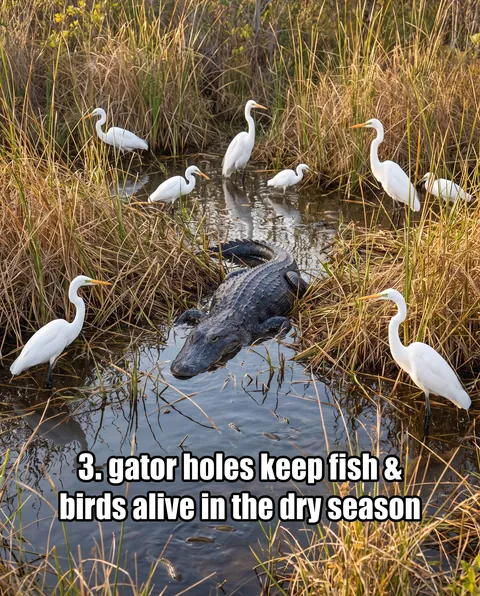
Wading birds feed in shallow water, and the Everglades is one enormous, shallow, slow-moving sheet of it. The key is the seasonal rhythm. During the summer wet season, fish and crayfish spread out across the flooded marsh. In the winter and spring dry season, the water shrinks back and those prey animals are concentrated into ponds, sloughs and alligator holes. That concentrated food is what lets many wading birds raise their young, which is why so many of them nest in the dry months.
Seven birds to know
Great egret
A tall, all-white bird with a yellow bill and black legs and feet. The National Park Service notes it stands over four feet tall with a wingspan of more than 50 inches, second in size only to the great blue heron. It hunts by standing still or walking slowly, then snapping up fish in a blink. In breeding season it grows long, lacy plumes on its back.
Snowy egret
Smaller and more delicate than the great egret, with a slim black bill, black legs and bright yellow feet. Birders call those feet golden slippers. Snowy egrets are active hunters, often shuffling or stirring the water with a foot to flush out small fish.
Great blue heron and the great white heron
The largest heron in North America, the great blue heron is a blue-gray bird that stands motionless for long stretches before striking. In South Florida you may also meet the great white heron, an all-white form found mainly in Florida Bay and the Keys. It looks like a great egret but is bigger and has pale yellowish legs. Experts still debate whether it is a color form, a subspecies or a separate species, but most treat it as a type of great blue heron.
White ibis
A white bird with a long, down-curved, reddish-pink bill and pink legs. Young birds are brown and white. Ibis often travel and feed in groups, probing the mud by touch for crayfish, insects and other small prey.
Wood stork
A big white bird with a bare, dark gray head and a thick, slightly curved bill. In flight it shows black edges on its wings. The wood stork is the only stork that breeds in the United States. It feeds largely by touch, sweeping its open bill through the water and snapping it shut when it contacts a fish, which makes it heavily dependent on the dry-season concentration of prey. After decades of protection and restoration work, the U.S. Fish and Wildlife Service removed the U.S. breeding population from the federal endangered species list in 2026. It is still listed as threatened under Florida law, and biologists continue to monitor its nesting closely.
Roseate spoonbill
Nothing else looks like it. A spoonbill is pink, sometimes nearly bubblegum bright, with a flat, spoon-shaped bill it swings side to side through the water to sift out small fish and crustaceans. Its color is generally attributed to pigments in the food it eats. Audubon researchers consider the spoonbill an indicator of Everglades health, because its prey depends on the right water levels and salinity in Florida Bay. Nest counts in the bay have dropped sharply since their peak in the late 1970s, even as spoonbills do well elsewhere in Florida.
Anhinga
Technically not a wader, but you will see it everywhere. The anhinga is a dark, long-necked swimmer whose feathers are not fully waterproof. That lets it sink low and hunt underwater, where it spears fish with its sharp bill. When it swims with only its thin neck showing, it looks like a snake, which earned it the nickname snakebird. Afterward it perches with wings spread wide to dry in the sun, one of the most familiar sights in the glades.
The plume trade and the birth of bird protection
In the late 1800s, fashionable hats across America and Europe were decorated with feathers, and the most prized were the breeding plumes of egrets and other wading birds. Plume hunters shot birds at their nesting colonies, when the plumes were at their best, leaving chicks to starve. The National Park Service notes that more than 300 great egrets were needed to produce a single kilogram of feathers. Spoonbills suffered too. Audubon reports that by 1890 nearly all of Florida's spoonbill colonies had been destroyed.
Public outrage grew, and a new conservation movement formed around the birds. Audubon societies organized to oppose the trade, and the great egret later became the symbol of the National Audubon Society. In 1902 the American Ornithologists' Union, at the urging of Audubon members, hired a Monroe County deputy named Guy Bradley as a warden to protect South Florida's nesting colonies.
On July 8, 1905, Bradley was shot and killed while trying to arrest a plume hunter near Cape Sable, at the southern tip of the Everglades. He was one of the first wardens in the country killed protecting wildlife. His death shocked the public and helped build support for stronger laws protecting nesting birds and ending the plume trade.
What has changed since
The plume trade ended, but wading birds still face pressure. The National Park Service has described a roughly 90 percent reduction in breeding pairs of wading birds in the Everglades, driven by drainage, development, water management changes and pollution. Restoring natural water flow is one of the main goals of Everglades restoration, and nesting numbers are one of the ways scientists measure progress.
From an airboat seat, the best thing you can do is simply watch. Give nesting and feeding birds space and keep noise down near rookeries.
Quick answers
What is the difference between a great egret and a snowy egret?
The great egret is larger, with a yellow bill and black feet. The snowy egret is smaller, with a black bill and bright yellow feet.
Why are roseate spoonbills pink?
Their pink color is generally attributed to pigments in the small crustaceans and fish they eat. Breeding adults show the brightest color.
Who was Guy Bradley?
Guy Bradley was a South Florida game warden hired to protect wading birds from plume hunters. He was killed in the line of duty near Cape Sable on July 8, 1905.
When is the best time to see wading birds in the Everglades?
The winter and spring dry season is usually best, because shrinking water concentrates fish and draws birds into feeding groups.
Sources
- Great Egret: Species Profile - Everglades National Park (NPS)
- Guy Bradley - Everglades Biographies, FIU Digital Collections
- Roseate Spoonbills Send Warning Signs About the Florida Everglades - Audubon
- Anhinga Overview - Cornell Lab All About Birds
- Removal of the Wood Stork From the List of Endangered and Threatened Wildlife - Federal Register (Feb. 10, 2026)
- Great White Heron: Not Just a Color Morph - Sibley Guides