The History of the Airboat and How It Came to the Everglades
The airboat is a flat-bottomed boat pushed by a large air propeller instead of an underwater one. That simple idea, with nothing hanging below the hull, is what lets it skim across a few inches of water and over sawgrass where other boats get stuck. Its roots go back to early aviation experiments in the 1900s, but it was Florida hunters, froggers and surveyors in the 1930s through the 1950s who turned it into the working boat of the Everglades.
Early experiments: Bell, Curtiss and the first air-driven boats
The earliest airboat usually mentioned is the Ugly Duckling, built around 1905 in Nova Scotia, Canada, by a team working with Alexander Graham Bell. Bell was experimenting with flight at the time, and the boat was a way to test propellers and engines on water. Some accounts also credit his collaborator Frederick "Casey" Baldwin with a role in this early work. By most descriptions it was heavy and slow, more a test bed than a practical craft.
Aviation pioneer Glenn Curtiss is often credited with building an air-driven boat around 1920, reportedly for getting around the Florida backcountry on hunting trips. Details of these early boats vary from source to source, so it is fair to say the idea was in the air, so to speak, among early aviators who had engines and propellers on hand.
Why the airboat caught on in the Everglades
The Everglades presented a problem that regular boats could not solve. The water is often only inches deep, thick with sawgrass, spatterdock and other plants that tangle a propeller, and spread across miles of flat marsh with few channels. Poling a skiff or canoe works, but it is slow and exhausting.
In the 1930s, local people started building their own air-driven boats. Florida accounts credit a frog hunter named Johnny Lamb with building one in 1933, and Ernest and Willard Yates of Chokoloskee with another around 1935. These homemade boats were rough, often wooden, and powered by whatever engine could be found. Early versions sometimes still steered with a rudder in the water.
Over the next two decades the airboat became a working tool. Froggers used it to gather frog legs for market at night. Hunters used it to reach remote hammocks. Surveyors, game wardens, researchers and firefighters used it to cover ground that was otherwise nearly impossible to cross. By the 1950s, airboats were a familiar sight on the canals and marshes west of Miami.
How an airboat works
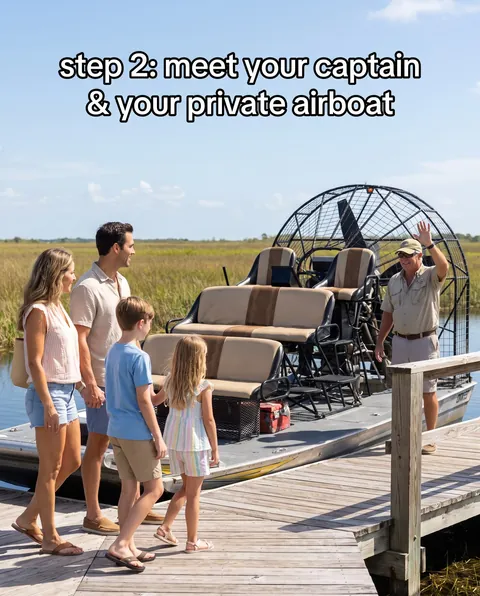
An airboat has three main parts: a flat hull, an engine with a propeller, and air rudders.
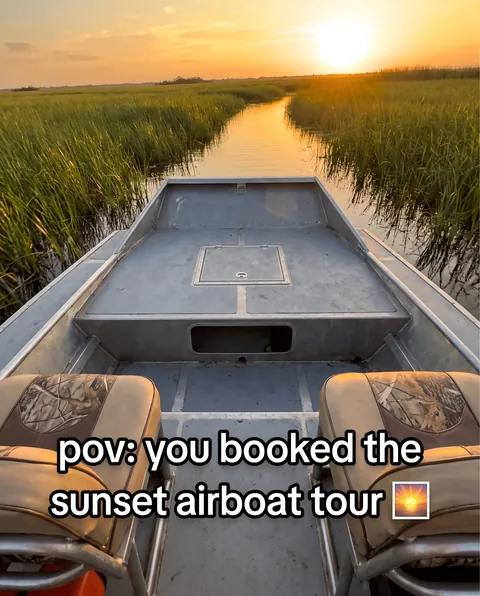
- The hull. Modern hulls are usually aluminum or fiberglass and nearly flat. Because the boat rides on top of the water, it draws very little and can slide over wet grass and even mud.
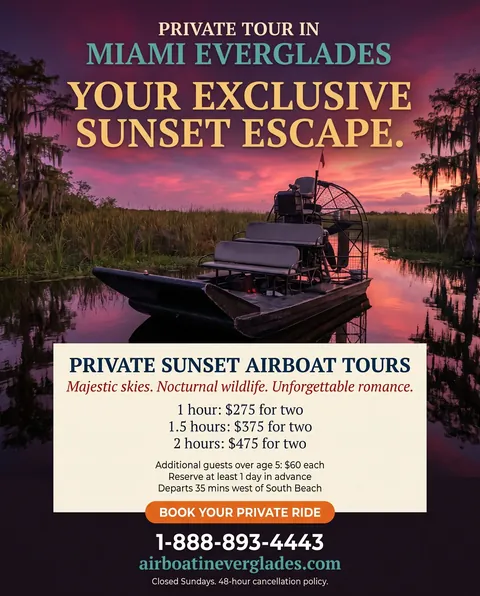
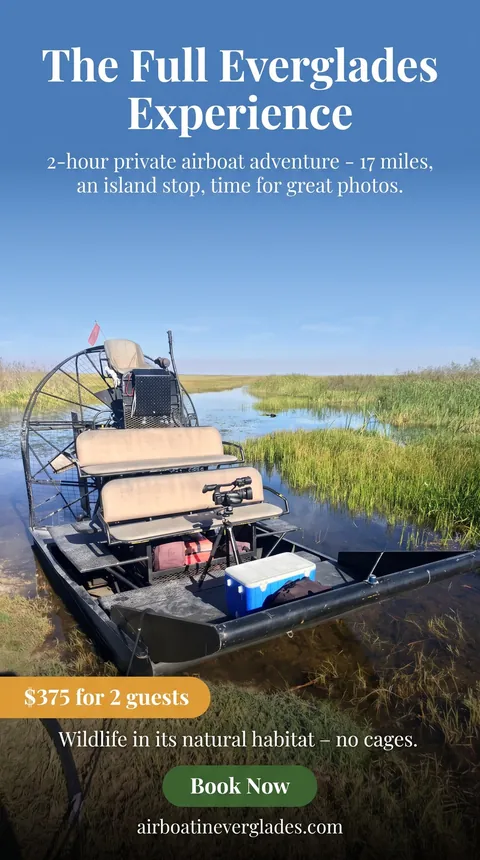
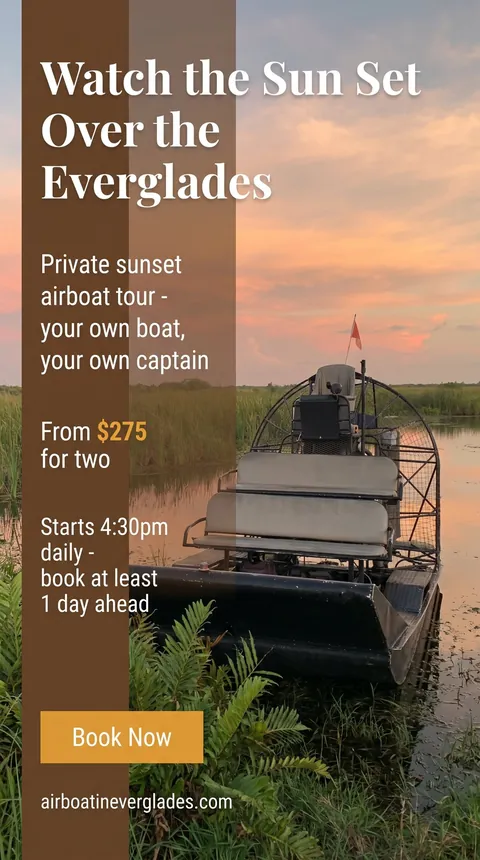
- The engine and propeller. Mounted high at the stern, an aircraft engine or an automotive engine, often a large V8, spins a big propeller inside a protective cage. The propeller pushes air backward, and that thrust moves the boat forward.
- The rudders. Large vertical rudders behind the propeller deflect the blast of air to one side or the other. The driver steers with a stick from a raised seat that gives a clear view over the grass.
There are no underwater propellers or rudders, which is why airboats can work in water too shallow and weedy for other boats. The tradeoff is that airboats have no brakes and no reverse in the usual sense. Slowing and turning take skill, especially at speed.
Noise and ear protection
Airboats are loud. Most of the noise comes from the propeller, with the engine adding the rest. Modern mufflers and multi-blade propellers have made boats quieter than they used to be, but the sound can still damage hearing with enough exposure. That is why operators hand out ear protection and why drivers wear headsets. If you ride, keep your ear protection on while the engine is running.
Florida law also requires airboats to have a muffler or similar device and to fly an international orange flag on a mast at least ten feet above the bottom of the boat, so other boaters can see them over tall grass. Operators carrying paying passengers must complete boater education, a state-approved airboat operator course and CPR and first aid training.
Where airboats can and cannot go
One common surprise for visitors is that airboats are not allowed in most of Everglades National Park. The main exception is the East Everglades Expansion Area, roughly 109,000 acres added to the park under a 1989 law. There, park-authorized commercial tours operate, and private airboat use is limited to people who held permits under rules tied to that law, with private use being phased out over time.
Most airboat tours you hear about operate outside the park, on the marshes and water conservation areas along the Tamiami Trail west of Miami and on lands managed by other agencies or owners. These areas are part of the same great system, and they hold the same sawgrass, tree islands, alligators and wading birds.
A responsible airboat ride keeps a respectful distance from wildlife, never feeds alligators, which is illegal in Florida, and slows down near nesting birds. Used that way, the airboat remains what it has been for nearly a century: the best tool for getting out onto the river of grass.
Quick answers
Who invented the airboat?
No single inventor gets full credit. An early air-driven boat called the Ugly Duckling was built around 1905 by Alexander Graham Bell's team in Nova Scotia, and Florida froggers and hunters developed practical Everglades airboats in the 1930s.
Why do airboats work so well in the Everglades?
They have a flat hull and no underwater propeller or rudder, so they can glide over shallow water and dense vegetation that would stop an ordinary boat.
Are airboats allowed in Everglades National Park?
Only in limited areas. Airboats are prohibited in most of the park, with authorized tours and limited permitted use in the East Everglades Expansion Area. Many tours operate on lands outside the park along the Tamiami Trail.