Mangroves of the Everglades: Red, Black and White
Follow the water of the Everglades south and west long enough and the sawgrass gives way to something completely different: a dense, tangled forest growing right out of salty tidal water. These are the mangroves, and Everglades National Park protects the largest contiguous stand of protected mangrove forest in the Western Hemisphere. They are where the fresh water of the River of Grass finally meets Florida Bay and the Gulf of Mexico.
What a mangrove is
"Mangrove" is not one kind of plant. It is a name for trees that have each found their own way to live in salt water, flooded mud and low oxygen, conditions that would kill most trees. South Florida has three true mangroves: the red mangrove, the black mangrove and the white mangrove. A fourth tree, the buttonwood, often grows just behind them on slightly higher ground and is usually included in the mangrove community.
Red mangrove: the one on stilts
The red mangrove (Rhizophora mangle) is the one most people picture. It stands on arching prop roots that drop from the trunk and lower branches into the water, giving the tree the look of something walking across the shallows. Its leaves are shiny and deep green on top and paler underneath. Red mangroves usually grow farthest out, along the water's edge and on the small islands that dot Florida Bay and the Ten Thousand Islands.
Red mangroves have a clever way of reproducing. Their seeds sprout while still on the tree, growing into long, pencil-shaped seedlings called propagules, about 10 to 12 inches long. When they drop, they can float for long periods until they lodge in shallow mud and take root. That is how new mangrove islands get started.
Black mangrove: the one with snorkels
The black mangrove (Avicennia germinans) usually grows a little higher up, behind the red mangroves. Look at the mud around it and you will see hundreds of pencil-like spikes sticking up, sometimes just an inch or two tall, sometimes several inches. These are pneumatophores, specialized roots that act like snorkels, letting the buried root system breathe in waterlogged mud. The bark is dark and scaly, and on a hot day you may notice a crust of salt crystals on the upper surface of the leaves, which the tree pushes out to get rid of excess salt.
White mangrove: the one with salt glands
The white mangrove (Laguncularia racemosa) tends to grow on the highest ground of the three. It has no dramatic prop roots or snorkels in most places. Instead, check the leaves: they are rounded at both ends, thick and the same pale green on both sides. Right where the leaf joins its stem are two small bumps, glands that excrete salt and sugary nectar. Those two dots are the easiest way to identify a white mangrove.
Buttonwood: the neighbor on higher ground
Buttonwood has gray, deeply furrowed bark and pointed leaves, and it produces round clusters of seeds that look like buttons, which gives it its name. It grows where tides reach only occasionally. One form, the silver buttonwood, has pale, almost silvery leaves and is a popular landscape tree in South Florida.
A nursery for the sea
Mangroves are among the most productive places on the coast. Their leaves fall into the water and break down into the base of a food web that feeds snails, crabs, shrimp and small fish. The roots create sheltered, shaded water where young fish can hide from predators. Many species that people catch and eat, including snook, tarpon, red drum, gray snapper, spiny lobster and pink shrimp, spend part of their lives in mangrove areas. The National Park Service describes the park's mangroves as a nursery for recreationally and commercially important marine species.
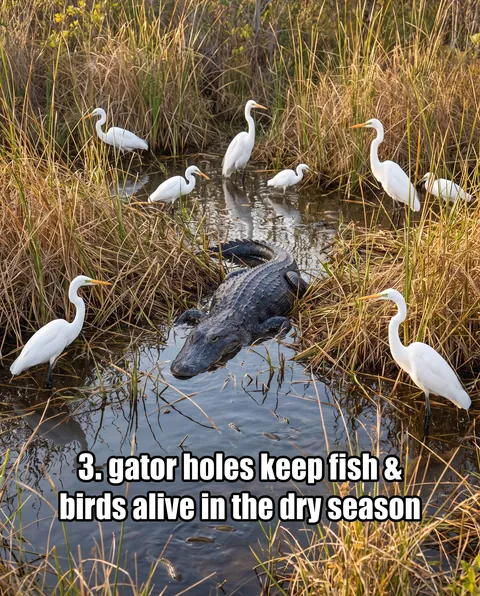
Birds rely on them too. During the dry season, wading birds gather in the mangroves to feed and nest. Roseate spoonbills, wood storks, herons and egrets all use mangrove islands, and Florida Bay's mangrove keys hold some of the most important wading bird colonies in the region. The mangrove zone is also home to the American crocodile, which prefers the brackish and salt water of the coast.
The first line of defense
When a hurricane comes ashore in South Florida, mangroves take the first hit. Their dense roots and branches slow storm surge and break the force of waves, protecting the lands behind them. They also trap sediment and help build up the coastline over time.
That defense comes at a cost. Hurricanes Andrew in 1992, Wilma in 2005 and Irma in 2017 all stripped and killed large areas of mangrove forest in the park. Most damaged areas recover, though some low spots where the soil collapsed have struggled. Scientists are watching closely, because rising sea levels add pressure, pushing salt water farther inland and moving the boundary between mangrove and sawgrass marsh.
Why fresh water matters at the coast
It might seem odd that mangroves, trees built for salt, depend on fresh water from far up the Everglades. But the health of the coast depends on the right mix. Fresh water flowing down Shark River Slough and Taylor Slough keeps the estuaries brackish rather than overly salty, supports seagrass in Florida Bay and keeps the nursery working. When upstream drainage cut that flow, Florida Bay suffered seagrass die-offs and algae blooms. Restoring the flow of fresh water south is one of the main goals of Everglades restoration, and the mangrove coast is one of the places where the results show up.
Seeing the mangroves
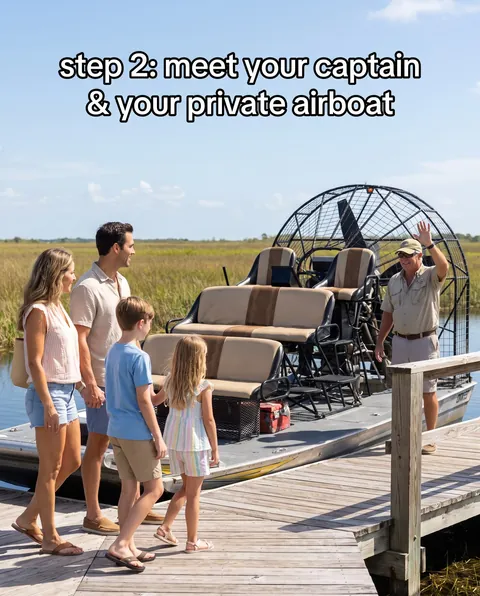
The mangrove zone is best explored by boat, kayak or canoe from Flamingo or Everglades City, where the Ten Thousand Islands form a maze of mangrove keys. Inland airboat rides on the freshwater sawgrass marsh show you the other end of the same system, the water that eventually makes its way to these forests.
Quick answers
How many kinds of mangroves grow in the Everglades?
Three true mangroves: red, black and white. Buttonwood often grows alongside them on higher ground.
How can you tell red, black and white mangroves apart?
Red mangroves stand on arching prop roots, black mangroves are surrounded by pencil-like breathing roots, and white mangroves have two small salt glands where the leaf meets its stem.
Why are mangroves important?
They shelter young fish and shellfish, support nesting birds, protect the coast from storm surge and trap sediment.
Do mangroves grow in the sawgrass marsh?
No. Mangroves grow along the coast, where fresh water from the Everglades mixes with salt water.